KBR 코리아비즈니스리뷰 · Section
ORGANIZATION & HR
KBR+
ORGANIZATION & HR
Work Redesign to Unlock Employee Capabilities: The Connection Between Inclusivity and Performance Revealed in German Enterprise Research
Based on revenue and employment disparities in German corporate research, this article analyzes the operational pathways, costs, and evaluation criteria of inclusive work operations.
김민경 Editor · 09/21/2026
Read more →
ORGANIZATION & HR
Two-Day Remote Work and a 33% Drop in Turnover: Performance and Talent Retention Conditions Seen Through Trip.com's Experiment
김민경 Editor · 09/17/2026

ORGANIZATION & HR
Why Skill Gaps Persist Even When Employee Training Increases: The Difference in Time and Opportunity Viewed Through OECD Adult Learning Data
박소유 Editor · 09/16/2026

ORGANIZATION & HR
Employee Feedback is Frequent, but Why Does Performance Remain the Same? Connecting Assessments to Behavioral Change
KBR경영연구소 · 09/16/2026

ORGANIZATION & HR
New Hire Onboarding: What to Do in the First 90 Days—Designing Roles, Relationships, and Execution Beyond Welcome and Training to Reduce Post-Hiring Gaps
류현진 선임기자 · 09/14/2026
ORGANIZATION & HR
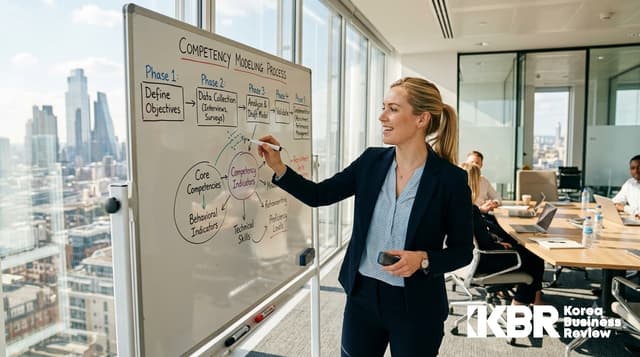
How to Design Competency Modeling Tailored to Your Organization
Competency modeling is the process of identifying required competencies based on specific behaviors observed in high performers within an organization. It is theoretically grounded in the Spencer family's iceberg model, which encompasses self-concept and motives alongside knowledge and skills. Competencies must be approached through three distinct tiers—company-wide core competencies, leadership competencies by rank, and job-specific competencies—as combining them into a single standard easily leads to a model disconnected from the field. The execution process spans six stages: setting objectives and scope, selecting target groups, data collection via behavioral event interviews or expert panels, developing a provisional model, validation, and finalization into a competency dictionary. This work should be carried out jointly by business unit leaders and management rather than the HR team alone. Rather than directly importing external frameworks, a hybrid approach that starts from and refines the actual behaviors of an organization's high performers is realistic, utilizing public standards such as the National Competency Standards (NCS) as reference frameworks. Once completed, the competency model serves as a common standard across all areas of human resource management—ranging from hiring interviews, competency evaluations, training, and succession planning to placement and compensation linkage—and risks remaining merely a document without regular reviews.
김민경 책임기자 · 08/10/2026
ORGANIZATION & HR
Can a Company Without an Org Chart or Reporting Structure Really Function?
From the mid-2020s, companies like Amazon, Google, and Citigroup began reducing middle management layers, a trend that accelerated in 2026 with layoffs at Meta (8,000), Cisco (4,000), and Block (4,000). In March 2026, Block CEO Jack Dorsey published an essay suggesting that middle management might not be permanently necessary, citing Zappos' holacracy and Valve's flat structure as direct reference points. However, Zappos and Buffer—both of which actually eliminated their org charts—eventually reintroduced managerial roles and 'natural hierarchies,' while even Valve has faced recurring criticism internally for 'hidden hierarchies.' Haier, often cited as a success story, did not eliminate hierarchy; rather, it redesigned management functions through market mechanisms such as profit-and-loss accountability and contracts. Gallup's latest 2026 data (showing a sharp decline in global engagement to 20% and manager engagement to 22%) demonstrates that the core of the problem is not the existence of managers, but their quality. It also shows that even the most radical redesign attempts in the AI era are ultimately reverting to the lessons left by past experiments: that the functions of coordination, evaluation, and development cannot be eliminated.
박소유 책임기자 · 08/10/2026

ORGANIZATION & HR
Characteristics of Companies Where Employees Stay Long-Term — Respect, Not Salary, Drives Long-Term Employment
Statistics Korea data shows that the average duration of a youth's first job is only 1 year and 6.4 months, and Incruit data indicates that the primary cause of early resignation is not salary but 'job mismatch' (58.9%), demonstrating that the key to long-term employment lies in organizational culture. According to Gallup's 2026 report, global employee engagement stands at only 20%, and while a 'great stay' phenomenon driven by economic uncertainty is emerging in South Korea, this resembles defensive retention rather than voluntary engagement. Companies where employees stay long-term share five common traits: phased onboarding, systematic handover processes, non-aggressive managerial feedback styles, clear roles and responsibilities, respect for rest and leaving work on time, and a peer culture free of hazing. Notably, 70% of the variance in team engagement stems from managers, and as Google's Project Aristotle confirmed, 'psychological safety'—where mistakes and questions do not lead to punishment—forms the foundation of high-performing teams and long-term employment. Long-term employment is not a matter of chance, but the result of an operational system designed to 'respect people'; because salary can be a reason to join, but respect is the reason to stay, investing in organizational culture is ultimately a matter of profitability.
김민경 책임기자 · 07/10/2026

ORGANIZATION & HR
You See the True Face of a Company During the Interview — The Real Reasons Candidates Walk Away
The center of gravity in the hiring market has shifted toward candidates, turning it into an era where key talent chooses companies among multiple offers rather than employers selecting applicants. According to a JobKorea survey, about 87% of job seekers have experienced unpleasantness during interviews, and over 80% reported that an interviewer's attitude alone changed their decision to join—making the interviewer's attitude more powerful than an acceptance notice. Companies must give candidates trust out of practical necessity rather than mere courtesy. The cost of hiring failures has grown, top talent evaluates companies based on their interview experience, and that experience spreads by word of mouth to dictate the employer brand. Interviews must project three elements: a prepared attitude toward the candidate, an unembellished reality of the role, and consistent and fair evaluation criteria that do not waver depending on the interviewer. The feeling left with candidates is a balance of hospitality and accurate evaluation, completed by details like advance notice, punctuality, and prompt result notifications along with interviewer training—interviews serve as a mirror reflecting the company, and candidates are already looking into that mirror.
김민경 책임기자 · 06/18/2026
ORGANIZATION & HR
MBO vs OKR: What's the Difference and Which Goal Management System Should Your Organization Adopt?
MBO is a goal management philosophy introduced by Peter Drucker in 1954, while OKR was developed by Intel's Andy Grove by combining it with 'Key Results,' meaning both share the same lineage. The essential difference is that MBO is a control tool linking goals to evaluation and compensation, whereas OKR is a tool that drives alignment and focus based on company-wide transparency. While MBO is annual, top-down, and assumes 100% achievement, OKR is quarterly, a hybrid of top-down and bottom-up, and views around 70% achievement as an appropriate stretch goal. MBO's strengths lie in clarity and stability, but its limits are conservative goal setting and rigidity; OKR's strengths are agility and stimulating innovation, but it easily becomes hollowed out without cultural maturity. The answer depends on an organization's volatility, cultural maturity, and operational purpose, though a phased strategy combining MBO for evaluations and OKR for directional alignment is also effective.
강지혜 선임기자 · 06/17/2026