KBR 코리아비즈니스리뷰 · Section
ESG MARKET & CASES
KBR+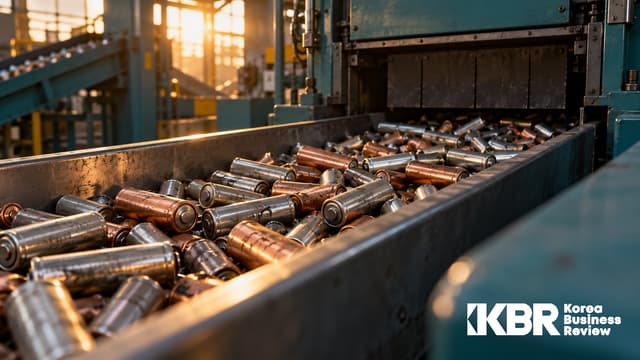
ESG MARKET & CASES
Opportunities in South Korea's Battery Recycling: Beyond Facility Capacity to Raw Materials and Sales Channels
Based on the IEA's Global Critical Minerals Outlook 2026, this article analyzes the opportunities and operational conditions for South Korea's battery recycling industry. It distinguishes between facility capacity, raw material securing, recovery quality, and sales and cash flow, providing evaluation criteria to prevent long-term projections from being misinterpreted as confirmed individual business performance.
박소유 Editor · 10/12/2026
Read more →
ESG MARKET & CASES
Server Reuse and Recycling: How to Read Microsoft's 92% Figure
이우리 Editor · 09/30/2026

ESG MARKET & CASES
Recycling 2 Million Mattresses Is Not the End: Raw Materials and Market Channels That Determine Circular Economy Profits
박소유 Editor · 09/20/2026

ESG MARKET & CASES
Better Water Use Efficiency Doesn't Eliminate Scarcity: Corporate Water Management Through the Lens of Microsoft
류현진 Editor · 09/18/2026

ESG MARKET & CASES
Patagonia's Circular Economy Blind Spot: Tasks Left After 170,000 Repairs
KBR경영연구소 · 09/17/2026
ESG MARKET & CASES
Does Changing Eco-Friendly Materials Guarantee Success for Reusable Packaging? Return Rates and Logistics Determine Business Viability
An analysis of the business viability of reusable packaging based on return rates, travel distance, washing capacity, and inventory status. The conditions for collaborative operation are explained using research from the Ellen MacArthur Foundation and repeated-return calculation examples.
이태민 Editor · 09/16/2026

ESG MARKET & CASES
Nike Shareholders Ask Again: Can the 2030 Reduction Targets Really Be Met?
A shareholder proposal demanding the disclosure of an implementation plan for existing climate reduction targets was defeated at Nike's virtual annual general meeting. Green Century sought a path and resource allocation plan to achieve existing targets rather than new ones. The Nike board maintained that current disclosures are sufficient and that targets and related disclosures are a matter for management to make a decision on. Pointing out that detailed explanations of implementation have decreased in recent public disclosures, institutional investors such as NBIM also cast public supporting votes. This case shows that the issue of ESG is shifting from declaring targets to a stage of proving the execution process and board oversight.
최수진 기자 · 09/09/2026

ESG MARKET & CASES
Beyond Paper Checks: Hyundai Motor's Supply Chain ESG Moves to On-Site Verification at Mines and Smelters
Hyundai Motor conducted ESG written assessments for 2,086 suppliers and on-site audits for 25 suppliers in 2025, while 25 suppliers with potential regulatory violations completed corrective action plans. Independent third-party RCS Global audited 3 mines and smelters in the Democratic Republic of Congo and Indonesia, identifying 58 non-conformities (47 major, 11 minor), with corrective actions currently underway. Legal experts generally view the EU Omnibus Directive, which took effect in March 2026, as clarifying risk-based due diligence rather than simply reducing audit volume. Through a mutual growth agreement signed with the Korea Fair Trade Commission in July, primary suppliers are paid within an average of 10 days post-closing instead of the statutory 60 days, while tier-2 and tier-3 suppliers are supported through training, incentives, and shared growth payments (benefiting an estimated 5,500+ companies). Despite achievements such as achieving RE100 across all operations in Europe, North America, and India, expanding the depth of in-depth audits and securing visibility into tier-2 and tier-3 suppliers remain future tasks.
류현진 선임기자 · 08/10/2026

ESG MARKET & CASES
Incheon Int'l Airport Corporation, Equipped with an ESG Committee, Failed to Stop Rampant Issuance of Parking Passes
An audit by the Ministry of Land, Infrastructure and Transport revealed that 31,265 regular parking passes—accounting for 84.5% of Incheon Airport's total 36,971 parking spaces—were issued without limit to employees and others. Short-term parking lots closest to the terminals were operated primarily for employees, reducing spaces available to general passengers by more than half. Numerous instances of private use were uncovered, including 1,220 cases of free parking during vacations, with waived fees amounting to 4.1 billion won in 2025 alone. As this occurred in a public enterprise equipped with an ESG committee and internal control systems, the gap between formal governance and substantive control has become a core issue. With improvement measures implemented in July sparking controversy over subsidiary discrimination, executing full recovery and disciplinary actions alongside equitable follow-up measures remains a pressing task.
강지혜 선임기자 · 07/10/2026

ESG MARKET & CASES
The Final Puzzle of Successful ESG Management: How to Design Organizational Culture
In 2026, ESG is in a paradoxical phase. While the US-driven backlash has reduced the usage of the term 'ESG,' regulations and practical demands are actually intensifying through EU CSRD/CBAM, Brazil's ISSB mandates, and South Korea's disclosure roadmap. Recent research and HR data show that corporate cultural orientation correlates significantly with ESG performance, employee satisfaction, and pride, suggesting that the success or failure of ESG depends on organizational culture rather than systems. Patagonia embedded its mission into its institutional and daily operations through benefit corporation conversion, ownership changes, environmental internships, and trust-based autonomy, realizing 'ESG driven by culture.' Unilever connected strategy, employee well-being, and ESG into a single operating system through the USLP, while global companies like Microsoft drive cultural shifts by linking executive compensation to sustainability metrics such as climate, workforce, and ethical AI. Principles of organizational culture design that South Korean companies can adopt include leadership internalization, institutionalization of values, employee participation experiences, speak-up cultures, and prudent compensation/KPI alignment. KBR's perspective is that as the regulatory phase deepens, only 'ESG embedded in culture' can withstand the post-ESG debate.
이지영 기자 · 06/30/2026