
KBR 코리아비즈니스리뷰 · Section
K KNOWLEDGE DICTIONARY
Free
경제용어
GDP Up 0.6%, GNI Up 3.1%: Why Do These Two Indicators Differ?
In the second quarter of 2026, real GDP rose 0.6% quarter-on-quarter, while real GNI increased by 3.1%. GDP measures domestic production, whereas GNI reflects the nation's real purchasing power, taking into account terms-of-trade and overseas income. A sharp 56.6% surge in the export deflator leading to massive real trade gains is the primary reason behind the gap between GDP and GNI. Nominal GDP jumped 26.4% year-on-year, but income growth was concentrated more heavily in gross operating surplus than in employee compensation. Consequently, export companies, domestic-market-focused businesses, and companies reliant on imported raw materials can experience vastly different business conditions despite the same macroeconomic indicators.
이태민 책임기자 · 09/09/2026
Read more →
경제용어
What is the Difference Between Treasury Stock Cancellation and Dividends? Analyzing SK Hynix's 40 Trillion Won Plan
강지혜 선임기자 · 08/21/2026

K지식
Employment Contracts, Annual Salary Contracts, and the Labor Standards Act: Which Prevails?
박찬호 선임기자 · 08/12/2026

K지식
Blistering Korean Peninsula: How Much Hotter Has South Korea Become Over the Past Decade?
강지혜 선임기자 · 08/02/2026

K지식
Same AI, Different Results: Core Principles of Prompt Writing According to Experts
이우리 선임기자 · 06/30/2026
K지식
How Strategy and Tactics Differ: The Crucial Distinction Between Designing Victory and Executing It
Strategy is a high-level concept that determines where an organization will win in the long term, while tactics are the specific execution methods used to achieve that goal. Strategy addresses long-term, comprehensive direction, whereas tactics are short-term, field-oriented action plans that flexibly adjust to changing circumstances. In the perspectives of both Sun Tzu and Carl von Clausewitz, strategy is distinguished as achieving the overarching purpose of an entire war, while tactics are the execution methods for individual battles. In modern management, strategy is a matter of market positioning and choice, while tactics are execution tools such as campaigns, pricing, channels, and programs. Ultimately, tactics without strategy is busywork without a purpose, and strategy without tactics is a plan that is never executed, meaning the two concepts must always work together.
박찬호 선임기자 · 06/27/2026

K지식
What is AX? A Transformation That Changes Not Just Tools, But 'How We Work'
AI Transformation (AX) goes beyond simply adding AI to a few tasks, representing a shift in which organizations completely redesign their ways of working around AI. While DX (Digital Transformation) focused on 'automation' by moving analog to digital, AX enters an 'autonomy' stage where AI learns, predicts, and judges on digitized data, with both concepts existing on a continuum rather than as opposites. Approximately 65% of global companies already utilize AI in daily operations (McKinsey, 2024), and governments and domestic companies like Samsung and Daesang have declared '2026 the First Year of AX' to accelerate the transition. The core of AX lies in 'redesigning work' beyond mere 'efficiency,' requiring a balanced interlock of four key elements: data, infrastructure, people (AI literacy), and culture. Because it can begin in small work units without massive investments, it presents an opportunity particularly for small and medium-sized enterprises, shifting the core question from 'Will we adopt AI?' to 'How will we redesign our work?'
이태민 책임기자 · 06/23/2026

경제용어
Inflation and Interest Rates: The Two Invisible Hands Shaping Corporate Fate
Inflation and interest rates are core variables underlying all corporate decision-making, including production costs, pricing, financing, and investment. Rising inflation increases the burden of raw materials and labor costs, with the ability to pass costs onto prices determining financial performance. Interest rates represent both the cost of capital and a traffic light for investments, with corporate borrowing thresholds rising as corporate bond and loan rates settled in the 4% range in 2026. Both variables move in tandem through monetary policy, and inflation trends serve as a signal for upcoming interest rate changes. With the base rate frozen at 2.50% and inflation in the high 2% range as of 2026, fortunes diverge by industry and size, requiring businesses to prepare by managing costs and capital simultaneously.
이태민 책임기자 · 06/22/2026

K지식
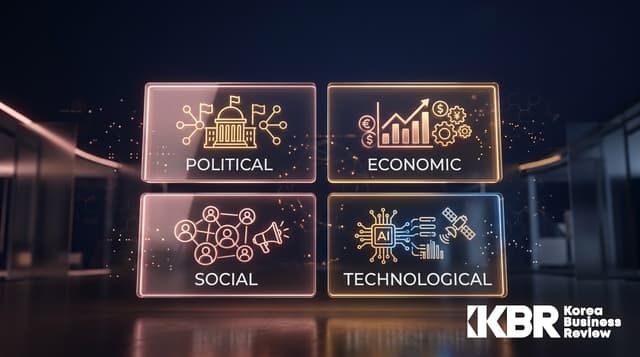
What is PEST Analysis? 4 Lenses to Read the 'Outside World' Surrounding Your Business
PEST analysis is a strategic management tool that thoroughly examines the uncontrollable macro-environment facing a company through four lenses: Political (P), Economic (E), Social (S), and Technological (T). Political factors act as a force changing the 'rules of the game' through policies, regulations, and taxes, exemplified by the electric vehicle subsidy case where 'policy is the market.' Economic factors (interest rates, exchange rates, inflation) directly affect consumption and investment decisions and must be viewed as interconnected flows rather than isolated indicators. Social factors (changes in values and perceptions) and technological factors (new technologies and battery competition) alter the market size and competitive landscape itself, with all four factors working in an interconnected manner. PEST is used to paint a big picture during the new business and market entry stages, which then leads to SWOT, and there is also an expanded PESTEL version that adds environmental and legal factors.
이우리 선임기자 · 06/18/2026
K지식
The Probationary Period Is 'Employment,' Not Just a 'Test' — Myths and Truths
Probationary workers are also official employees under the Labor Standards Act. The probationary period is a time for new hires to adapt to their tasks and organization, and for employers to evaluate their job skills and organizational fit. However, since probation is a stage following official hiring, probationary workers are still employees under the Labor Standards Act. If the employment contract is signed for one year or longer, 90 percent of the minimum wage can be paid for the first three months. With the minimum wage rising to 10,320 won per hour for 2026, the reduced hourly wage during probation is 9,288 won, which corresponds to 90 percent of 10,320 won. However, minimum wage reductions cannot be applied to all probationary workers. Reductions are not permitted if the employment contract period is less than one year. In addition, minimum wage reductions cannot be applied to workers engaged in simple physical labor corresponding to major group 9 of the Korean Standard Classification of Occupations, and the full minimum wage must be paid in such cases. The reduction application period is limited to a maximum of three months. While it is possible to set the probation period itself to three months or longer, 100 percent of the minimum wage must be paid for the period exceeding three months. The probationary period must be clearly stated in the employment contract to be recognized as a valid probationary agreement. The probationary period is included in the length of service, and the employment relationship does not start anew simply because the probation has ended. Furthermore, dismissal notice regulations may not apply to workers with a continuous service period of less than three months, but valid reasons are still required for the dismissal itself.
이우리 선임기자 · 06/15/2026