A Growing Economy and a Profitable Business Are Different: Conditions in Manufacturing, Consumer Markets, and Localization That South Korean Companies Must Reexamine
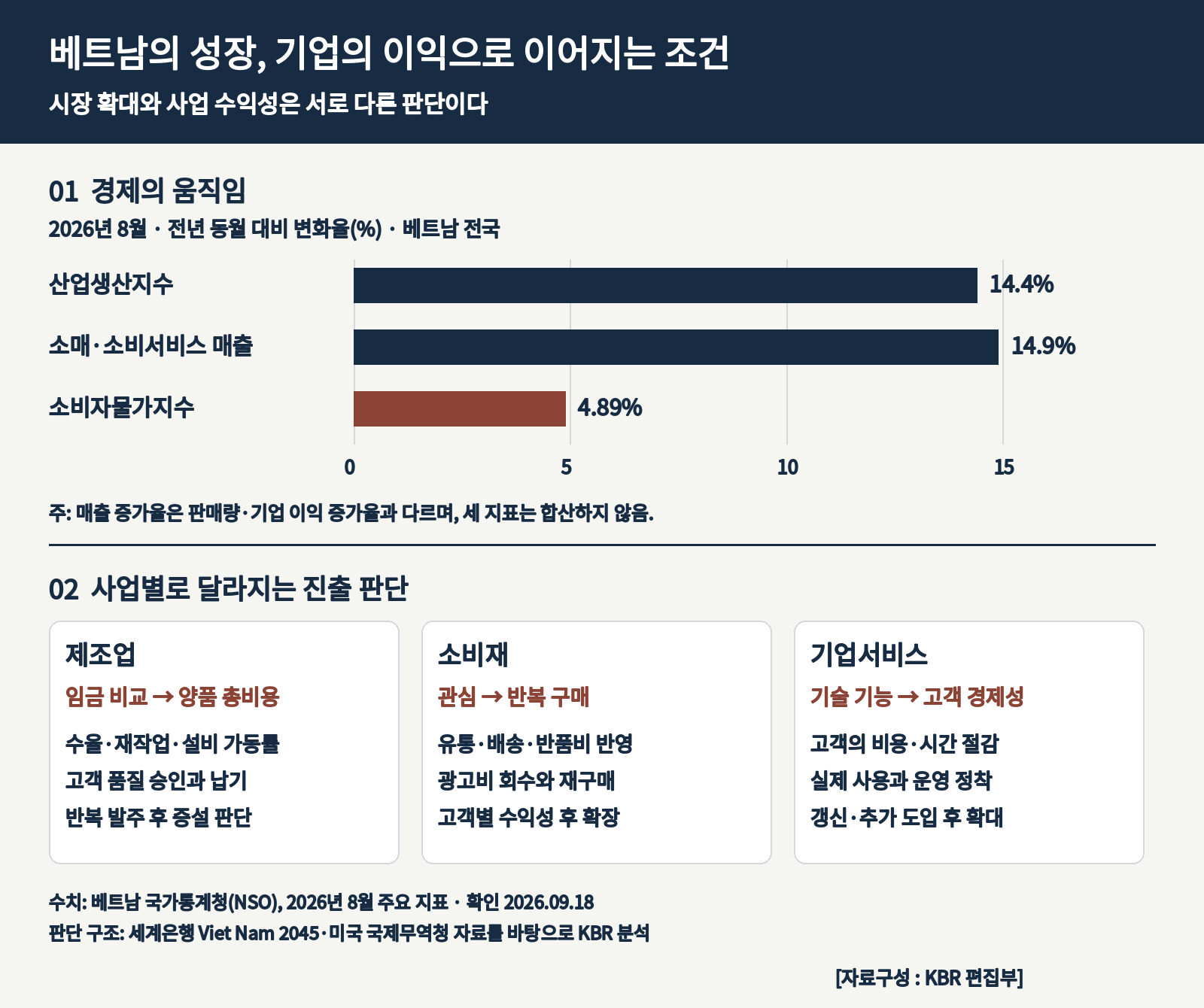
It is still too early to say that opportunities in Vietnam have come to an end, as the economy remains active. According to key indicators for August 2026 released by the General Statistics Office of Vietnam, the index of industrial production increased by 14.4% compared to the same month of the previous year, while retail sales of goods and consumer services revenue grew by 14.9%. The consumer price index rose by 4.89% in the same month. Although production and consumption are expanding together, an increase in sales revenue cannot be directly interpreted as an increase in sales volume or corporate profits. Even in a growing market, the business conditions felt by operators vary depending on changes in prices, costs, and competition.
This is the exact question faced by companies considering market entry into Vietnam. It revolves around whether the mere fact that the economy is growing provides sufficient reason to relocate a factory, whether an increase in consumption justifies opening a retail store, and whether products and operational methods that succeeded in South Korea can generate equivalent profits locally. A gap exists between a nation's potential and the success of individual businesses that cannot be explained by statistics alone.
Therefore, to determine whether Vietnam is still a land of opportunity, the question needs to be reframed slightly. Which companies solve which customer problems to capture opportunities? A business that exploits past cost differentials and a business that helps improve future productivity are entering entirely different markets, even if they invest in the same Vietnam.
High Growth Rates Do Not Lift the Performance of All Companies
In its current country overview for Vietnam, the World Bank projects an economic growth rate of 8% for 2025 and 6.8% for 2026. While the 2026 figure is a projection rather than annual performance data, it serves as a benchmark for evaluating the expansion potential of the Vietnamese economy. At the same time, the World Bank points out an open economic structure where the trade-to-GDP ratio reaches approximately 170%. The strength of being deeply connected to the global market also serves as a conduit through which external demand and changes in the trade environment are transmitted domestically.
Under this structure, a boom in export manufacturing and a boom in regional consumer markets may not move at the same speed. Even if production increases at a factory receiving export orders, if procurement of parts is sourced overseas or the benefits are concentrated among companies with limited additional profits, it is difficult to view purchasing power as evenly distributed across neighboring shops and service industries. Securing profitability in consumer businesses is not guaranteed simply by virtue of being located in an area with a factory.
National growth rates explain the direction of the market, but they do not reveal who the customers are. For companies selling industrial equipment, factory capital expenditure budgets and purchasing approval procedures are crucial, whereas for companies selling consumer goods, actual household spending capacity and repurchase cycles are critical. This is why companies must establish entirely different business plans even when looking at the same growth rate.
Particularly for early-stage market entrants, the range of reachable customers is a more useful starting point than the total market size. Rather than calculating a percentage of total Vietnamese consumers to capture, the connection between revenue and costs is established by determining what price-range products can be sold to customers in a specific region and how frequently they make purchases. Breaking down a massive market into smaller segments does not reduce opportunity; rather, it transforms it into an executable business.
From a 'Cheap Production Base' to a 'Stable Production Hub'
Evaluating Vietnam from a manufacturing perspective requires more than just comparing wage levels. In its market guide from March 2026, the International Trade Administration (ITA) of the U.S. Department of Commerce cited location, labor costs, the foreign investment attraction environment, and trade agreement networks as Vietnam's competitive advantages, while also highlighting infrastructure constraints, initial business costs, and a shortage of skilled labor as distinct risk factors. This indicates that low costs and high execution difficulty can coexist simultaneously.
A factory's competitiveness is determined not by an individual worker's monthly salary, but by the total cost of a single defect-free unit delivered within the required deadline. Even if labor costs are low, initial cost advantages diminish if defects and rework increase, repair personnel are difficult to secure when equipment breaks down, or parts procurement takes time. Adding the living and training expenses of foreign managers alongside capital tied up in safety stock means the economic feasibility of factory relocation may differ from initial expectations.
For instance, if a component manufacturing company considers production in Vietnam, decision-making cannot conclude with a simple comparison of salary tables between a South Korean plant and a local facility. Factors such as the time required to obtain quality approval from existing clients, the timeline for stabilizing initial production yields, and the ability to handle client-requested modifications on-site must be calculated together. This is because a significant operational process lies between the day production capacity is secured and the day revenue begins to be normally recognized.
Conversely, companies with the capability to manage these processes unlock opportunities beyond mere low wages. Examples include businesses that enhance clients' facility utilization rates and delivery reliability, such as equipment maintenance, quality inspection, process automation, and production management systems. Evaluating the competitiveness of a production hub based on total cost means that not only owning a factory, but also making that factory run more stably, is a viable way to participate in Vietnam's manufacturing sector.
The Gap Remaining Between Export Growth and Local Supply Chains
An important clue for understanding Vietnam's industrial structure is the connection between foreign enterprises and local companies. The World Bank's 2024 report, *Viet Nam 2045: Trading Up in a Changing World*, explains that the participation rate of local companies in global value chains—based on its own definition—dropped from 35% in 2009 to 18% in 2023. This is an indicator that examines companies' international connectivity, encompassing imports, exports, and the utilization of foreign technology, rather than a simple domestic component localization rate.
This outcome challenges the expectation that rising exports will automatically upgrade the entire local industry as a whole. The capability to assemble finished products, the capability to design and produce core components, and quality management capabilities meeting international client demands are distinct skills. The mere arrival of large-scale production facilities does not ensure that all surrounding enterprises can participate in those supply chains.
Opportunities for South Korean companies can also be identified more specifically within this gap. While one can start by selling existing products locally, another viable approach is to jointly improve processes and inspection systems to help local partners meet client quality standards. In this case, competitiveness does not lie solely in the product itself. Operational capabilities—such as tracing root causes when issues arise, verifying correction results, and repeatedly delivering consistent quality—underpin commercial relationships.
However, entering the supply chain can be a business with a long timeline between meeting clients and concluding transactions. This is because prototype evaluations, supplier audits, unit price negotiations, and formal purchase orders occur in distinct stages. Interpreting inquiries as demand and purchase intentions as advance revenue can lead to a situation where facilities and manpower are expanded prematurely while waiting for orders. In this market, a financial structure capable of enduring the cash and time required for the customer approval process is just as important as growth potential.
As the Consumer Market Grows, Customers Must Be Defined More Narrowly
A different kind of optical illusion occurs in the consumer market. While the fact that sales revenue is increasing is attractive, opportunities for new entrants vary depending on which regions, income brackets, and distribution channels are driving that growth. The U.S. International Trade Administration also highlights purchasing power in major cities and demand for consumer goods and services when explaining market opportunities in Vietnam. This approach is distinct from viewing the country as a single, uniform consumer market.
The core of a consumer goods business does not stop at whether local customers like a product. It must align with the actual price they are willing to pay, the distribution channels they trust, and whether they continue to choose the same product after an initial purchase. If sales drop sharply for a highly anticipated product once discounts or advertising are halted, a gap remains between market response and a sustainable business.
Localization is likewise difficult to understand at the level of translating names and packaging phrases. Package sizes tailored to customer purchase frequencies, functions adapted to usage contexts, delivery and return experiences, and the language and speed of customer support are all parts of the product. Bringing South Korean retail configurations directly without modification versus designing configurations tailored for local repeat purchases can result in completely different profit and loss outcomes, even when using the same brand.
For this reason, entry into the domestic consumer market requires demonstrating profitability per customer prior to focusing on store counts or distribution channel numbers. The basis for expansion lies in how much remains after deducting product costs, distribution commissions, shipping fees, and return burdens from a single order, and whether the cost incurred to acquire that customer can be recovered through repeat purchases. If losses accumulate with every order despite rapid revenue growth, the market's growth rate can actually exacerbate capital burdens.
Relocating Supply Chains Does Not Eliminate External Shocks
Vietnam also attracts attention from the perspective of diversifying production hubs. However, changing a factory's address and diversifying supply chain risks are not the same thing. The World Bank's 2024 trade report analyzed a structure where increased exports from Vietnam to the U.S. were accompanied by a rise in imports of Chinese components, pointing out that reliance on specific supply sources can remain a vulnerability.
Even if a South Korean company manufactures in Vietnam, if it purchases core raw materials from a single country and relies on specific markets for final sales, it is difficult to judge that risks have been sufficiently mitigated solely through the geographical dispersion of production facilities. Actual resilience is determined by whether alternative procurement is possible when a supplier halts operations, whether different products can be manufactured in response to changing client orders, and whether delivery routes can be altered.
Differences in transaction currencies and cash flows must also be considered. A business that receives local sales proceeds in Vietnamese dong while purchasing raw materials in U.S. dollars is exposed to exchange rate fluctuations in a manner different from a business that receives export proceeds in dollars. Business plans that simply raise sales forecasts by a uniform percentage fail to reveal this difference. Profit volatility becomes visible only when the cycle for adjusting selling prices and the timing for paying purchase costs are mapped together.
Consequently, supply chain strategies utilizing Vietnam must be more sophisticated than the single phrase 'a substitute for China.' The clearer the plan regarding which processes to relocate, which component sources to diversify, and which clients to respond to more rapidly, the clearer the purpose of the investment becomes. Operational improvements stemming from relocation, rather than relocation itself, must explain business viability.
Issues with Institutions and Infrastructure Are Both Costs and Demands
The World Bank report *Viet Nam 2045—Breaking Down Barriers* emphasizes that predictable regulations, effective public investment, and administrative implementation capacity are crucial for Vietnam's transition to a high-income nation. In particular, it notes that creating new regulations and applying them consistently in the field are entirely separate challenges.
From a corporate perspective, this gap impacts timelines and capital. When facility operation timelines in a business plan diverge from actual operational dates, rental fees and labor costs accumulate while revenues are pushed backward. This is why the scope of responsibilities undertaken by contracted partners, who bears costs when delays occur, and the stage of administrative procedures required for operations are directly tied to profitability.
Infrastructure can be viewed from the same perspective. The World Bank's green growth report explains that climate risks can impact not only agriculture and transportation, but also urban and industrial hubs. When companies select production facilities or warehouses by comparing only rental rates, costs such as inventory loss or shipping disruptions caused by flooding can appear belatedly. This background highlights the need for an approach that evaluates individual location risks as operational conditions.
These constraints do not necessarily warrant abandoning market entry. Capabilities such as improving power and water usage efficiency, minimizing equipment downtime, and stably managing inventory and logistics can deliver economic value to clients. However, the existence of a socially necessary solution does not instantly make it a purchasable product. If the party bearing the costs differs from the party receiving the benefits, or if the investment recovery period exceeds client expectations, securing contracts based solely on technological superiority is difficult.
South Korean Corporate Experience Is a Starting Point, Not the Final Form of Local Competitiveness
The operational experience in manufacturing, distribution, and services accumulated by South Korean companies is an asset that can be leveraged in Vietnam. However, transferring that experience resembles redesigning it to fit local conditions rather than delivering a finished answer. If equipment that boosted productivity in South Korea is excessively large for local production volumes, or if management systems are difficult for workers to use without extensive training, the advantage of having numerous features can instead turn into an adoption burden.
What matters in this context is the scope of change clients can absorb, rather than the level South Korean companies wish to provide. Rather than proposing a complete overhaul of all processes from the outset, a more realistic approach may be solving problems in a single process where defects are concentrated and expanding to the next stage once effectiveness is verified. The closer the correlation between the amount paid by the client and the actual reduction in costs, the easier it is to build trust post-contract.
The role of local organizations must also evolve. Relying solely on personnel who transmit headquarters-made decisions makes it difficult to adequately reflect customer complaints, competitor responses, and price fluctuations in the business model. The degree of local decision-making authority permitted, alongside the permissible limits for price adjustments and service supplements, dictates the speed of market response. Localization designed without combining control and delegation is likely to remain headquarters-centric operations under a different name.
The initial objectives of market entry can also focus on securing repeatable transactions rather than aiming solely for total sales volume. For manufacturing, this means repeat orders for products that have passed quality approval; for consumer goods, repeat purchases with reduced reliance on discounts; and for corporate services, client renewals and additional adoption. Rather than dismissing initial contract outcomes, this approach involves verifying whether the same method succeeds with subsequent customers before increasing fixed costs.
Opportunities in Vietnam Are Not Disappearing, But Their Conditions Are Becoming More Specific
Optimistic and cautious views on Vietnam do not inherently contradict one another. While production and consumption expand, challenges may persist in skilled labor, supply chain connectivity, regulatory execution, and infrastructure. The same environment acts as a burden to companies expecting simple cost reductions, while serving as a business starting point for companies capable of enhancing customer productivity and reliability.
Ultimately, the criteria for deciding to enter Vietnam must move one step deeper than national growth potential. Businesses must be able to articulate whose spending can be secured, why those customers will abandon existing alternatives to choose them, and how profits and cash will remain after factoring in all local operational costs. Ventures with weak links here may struggle despite high growth rates, whereas ventures with clear links retain room to respond even when the macroeconomic environment fluctuates.
Is Vietnam still a land of opportunity? Considering the expansion of production and consumption alongside the need for industrial upgrading, grounds for finding opportunities remain. However, those opportunities are shifting away from the expectation that "entering Vietnam will lead to growth" toward the question of "which problems in Vietnam can we solve better?"
South Korean companies need neither blind optimism nor wholesale withdrawal. What is required is examining what new value customers are willing to pay for, alongside how much cost advantage remains. Riding the wave of Vietnam's growth is distinct from building a sustainable business within that growth momentum. Today, what separates opportunity is not the act of market entry itself, but whether a company possesses the reasons to be repeatedly chosen locally.